Home Improvement Planner: How to Organize Your Home Goals
Build a home improvement planner that keeps every room’s ideas, budget, and next steps in one place. The 6 sections to include and how to choose paper or digital.
A good home improvement planner has six parts: a room-by-room idea list, a priority list, a style and color reference, measurements, a budget tracker, and a next-steps list. Keep it all in one place you will actually open. If you have ever stood in a store without your rug measurements, this home project planner fixes that. Homeowners are planning more than ever, and a simple system keeps all those ideas from staying scattered.
Key Takeaways
Table of contents
- Why do you need a home project planner?
- What should a home project planner include?
- How do you choose between a paper, digital, or app planner?
- How do you organize home projects by room and priority?
- How do you track a home project budget in your planner?
- How do you keep your home planner updated all year?
- What does a filled-in home project planner look like?
- Frequently Asked Questions
- Final Thoughts on Your Home Project Planner
Disclaimer: This post contains affiliate links. To read more, check out our disclosure policy. As an Amazon Associate, I earn from qualifying purchases
Why do you need a home project planner?
You need a home project planner because it saves money, saves time, and reduces decision fatigue. When ideas live in 400 pins, three notebooks, and your head, you make purchases from memory and buy the wrong size or the wrong color.
Planning also protects your budget. The 2026 Houzz & Home Study reports that 75% of homeowners set an initial budget, yet 37% exceeded it in 2025. A planner keeps the number in front of you at the moment you are deciding.
At my age with two little kids running around, I operate on the fact that if it’s not written down, it doesn’t exist. That’s why it so freeing to get everything out of my head to create more space for being present rather than trying to hold information that can live in my “external brain.”
What should a home project planner include?
Disclaimer: This post contains affiliate links. To read more, check out our disclosure policy. As an Amazon Associate, I earn from qualifying purchases
A home project planner should include six sections: a room-by-room idea list, a priority list, a style profile and color palette, measurements and floor plans, a budget tracker, and a next-steps timeline. These six cover every decision you will make.
1. Room-by-room idea list
Give each room its own page or tab. Capture ideas, inspiration photos, and links in one place. Our post on organizing home ideas shows how to capture, group, and rank them.
2. Priority list
Rank projects by impact and effort. Tag each as a quick win or a saving-for project.
3. Style profile and color palette
Keep your paint colors, finishes, and non-negotiables here. If you do not have a style profile yet, read what is a decorating style profile, and see how to build a whole home color scheme.
4. Measurements and floor plans
Record room dimensions, ceiling height, window sizes, and furniture sizes. Take these to the store on your phone.
5. Budget tracker
Track estimate, actual, and a splurge-versus-save note for each item. Our room makeover budget post shows the steps.
6. Next steps and timeline
List the very next action for each project, with a date. One small next step keeps momentum.
How do you choose between a paper, digital, or app planner?
Choose a planner format by where you already spend time each day. The best planner is the one you will open, so a paper binder, a spreadsheet, or an app can all work.
| Format | Best for | Watch out for |
|---|---|---|
| Paper binder | People who like to sketch and hold things | Hard to search, easy to leave at home |
| Google Sheets or Notion | People who like formulas and links | Can get cluttered without a template |
| Trello or ClickUp | People who track tasks by stage | Ideas and photos need extra setup |
| Workshop system | People who want a guided setup | Requires time to complete |
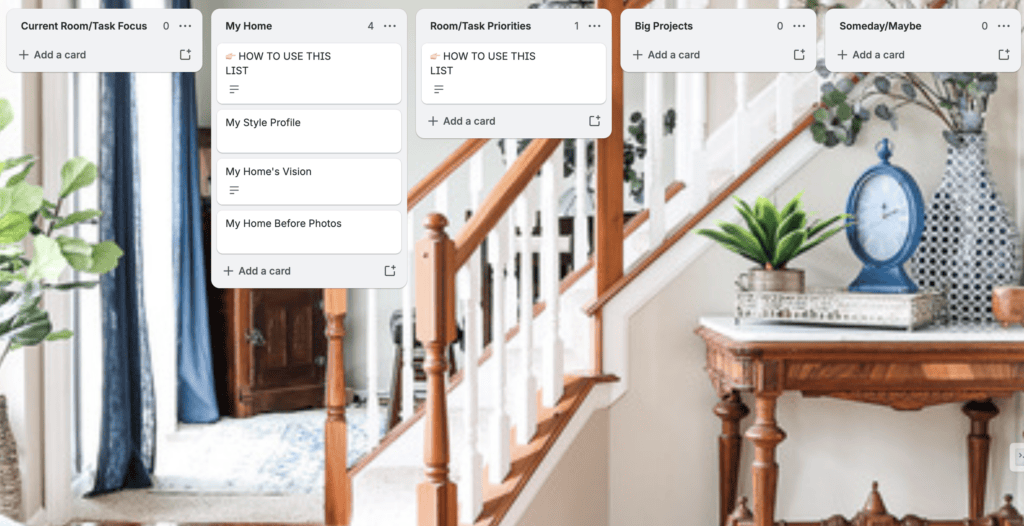
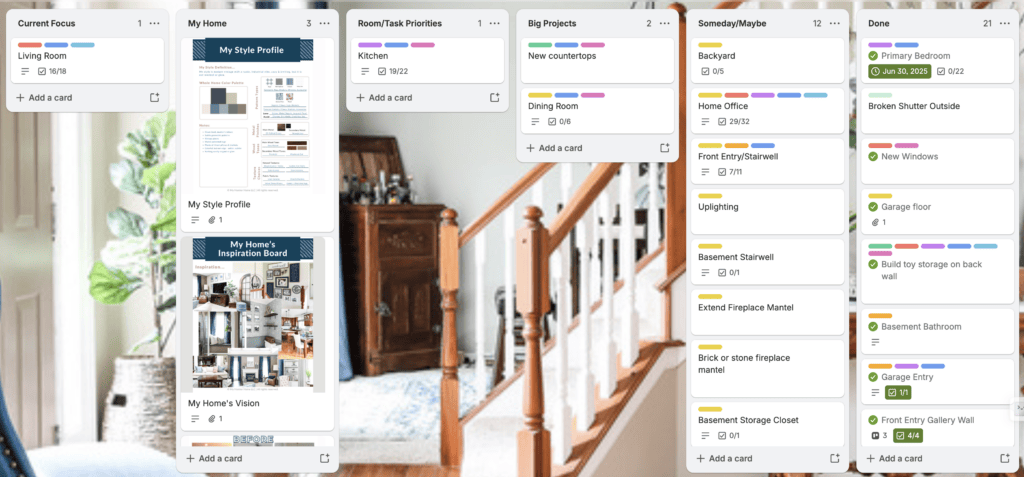
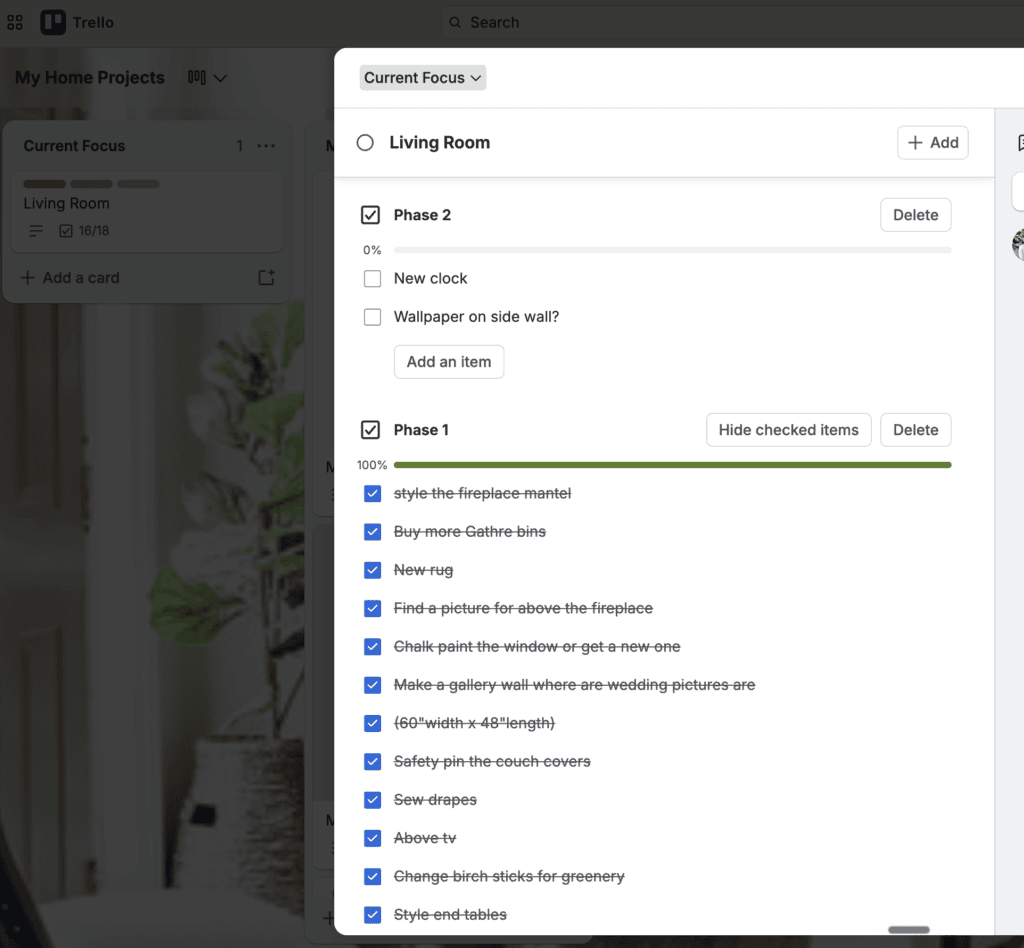
I’m 100% a digital girly so Trello or ClickUp (or even Asana) are some of my favorite tools.

If you want a guided setup, the Dream Home Idea Vault Workshop walks you through building one.
How do you organize home projects by room and priority?
Organize home projects by giving each room its own tab or list, then tagging every project by priority and season. Add two labels, “quick win” and “saving for,” so you always know what to tackle next.
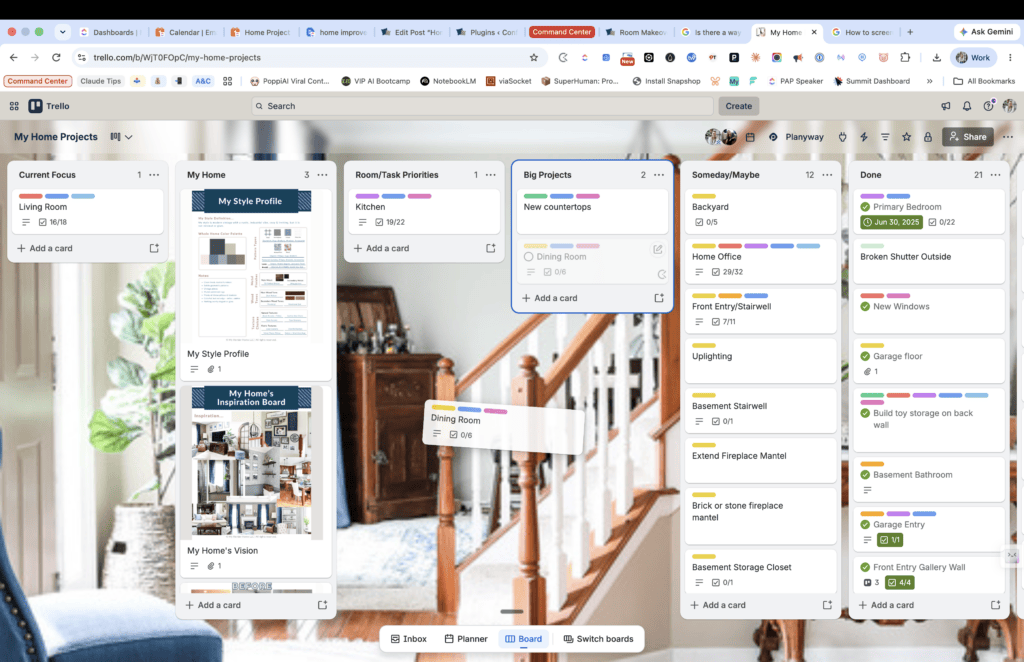
Use three tags: priority (high, medium, low), season (spring, summer, fall, winter), and status (idea, planned, in progress, done). Then sort by priority and season each month. The Dream Home Idea Vault Workshop uses this approach with room-by-room pages. I like using Trello because you can drag and drop to reorder your rooms as you can see in the photo below.
How do you track a home project budget in your planner?
Track a home project budget with three columns: estimate, actual, and splurge or save. Keep all receipts in one folder so totals are easy to check.
The numbers show why this matters. The Houzz study puts median renovation spending at $20,000 in 2025, and Angi’s 2026 poll of 1,000 homeowners found 43% of those who hired a pro had the cost exceed the original quote, with more than a third of those spending at least 30% more. Add a buffer line to your planner for the unknowns.
| Item | Estimate | Actual | Splurge or save |
|---|---|---|---|
| Living room rug | |||
| Paint |
But if you really want to keep track of your budget the right way, I would definitely check out the Room Makeover Budget Buddy.

Need a way to easily keep track of and budget for your room makeover? The Room Makeover Budget Buddy Spreadsheet is THE thing you need. Learn more here.
How do you keep your home planner updated all year?
Keep your planner updated with a 20-minute monthly check-in: cross off finished work, move one project up, and set the next step. Tie the check-in to the change of seasons or the first weekend of the month. If you’re using Trello or another digital method, you can do this easily on your phone while you’re on the go.
Angi’s 2026 report also found 56% of homeowners plan to begin or continue a home project in the next three months, so a quick monthly review keeps you in that group instead of falling behind. A 30-minute weekly reset routine pairs well with it.
What does a filled-in home project planner look like?
A filled-in home project planner has one page per room with ideas, priority, palette, measurements, budget, and next step. Here is a sample for a living room.
- Ideas: New rug, layered lighting, gallery wall
- Priority: High, quick win
- Palette: Navy, greige, soft green
- Measurements: Room 14 by 18 feet, window 36 by 60 inches
- Budget: Estimate, actual, and buffer
- Next step: Measure the rug area this Saturday
For a room-planning walkthrough, see how to design a room.
Helpful Tools
- Dream Home Idea Vault Workshop – A guided workshop for gathering every idea in one place.
- Room Makeover Budget Buddy – A budget tool for planning what each room will cost.
Frequently Asked Questions
The best app is the one you already use daily. Trello, Notion, Google Sheets, and ClickUp all work with the six sections above.
You can build one for free in Google Sheets or a notebook using the six sections in this post.
Set the feeling, measure the room, choose your palette, set a budget, then list your next steps. Our how to design a room post walks through it.
Plan the next three months in detail and the next year in rough priority order.
No. Start with one or two rooms and add more as you go.
Final Thoughts on Your Home Project Planner
A home project planner is a decision tool, not a pretty notebook. One place for ideas, measurements, and budgets means fewer wrong purchases and more finished rooms. Progress beats perfection, so start with one room. If you want support and follow-through, join the Calm & Confident Decorating Community.
About the Author

Christin Cieslarski is the founder of My Homier Home and the creator of the Confident Decorating® method. She helps busy women go from stuck and second-guessing to calm, confident, and actually making progress on their homes… one steady step at a time.
Last Updated:
More Decorating Help
If you enjoyed this post, make sure to pin the image below for reference later!